


 This blog was previously posted in May, 2018 and came to mind the other day when in contact with some travellers with whom I shared a journey to Africa. I want to re-share it with you.
A few years ago, I had the privilege and joy of travelling to South Africa, Namibia and Zimbabwe. It was a tremendous journey in so many ways, including that, for me, travel is transformative and a great equalizer. That is, in middle of the desert and savannahs, and in big and small cities – far from home – it feels we are defined only by our presence in the moment. (I try to hold onto this feeling as long as possible!)
Whenever I travel I learn so much, and it will come as no surprise that even in my travels, I am attuned to the word ‘conflict’ and how it is managed in various cultures. And this article is about a conflict I became aware of between humans and cheetahs.
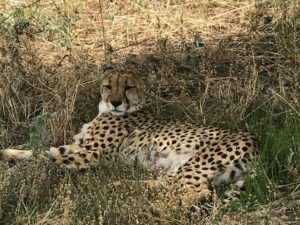
Cheetahs are known as the world’s fastest land animal and as the oldest and most unique of the big cats of Africa. Reportedly, their ancestors appeared on earth more than four million years ago – before lions and leopards. Unfortunately, the numbers of these magnificent cats have dwindled as to be near extinct and apparently, they are extinct in 25 of the 45 countries where they have lived over the last 60 years. One reason attributed for this is due to the conflict between humans and them.
This particular conflict was identified in Namibia by Dr. Laurie Marker, an American conducting research in Africa since 1977. She saw a need to save cheetahs, attributing their decline in numbers to their loss of habitat, loss of prey and indiscriminate killing by farmers who viewed them as vermin and a threat to their livestock.
Through remarkable programs to assure the cheetah’s place on our earth, Dr. Marker set out to ensure they could live harmoniously with humans. And thankfully, the amazing initiatives she and her team of interns and volunteers (and some staff) implemented through the Cheetah Conservation Fund (CCF) have significantly increased the number of cheetahs in Namibia.
A few of the programs that have reduced the conflict include educating farmers through research about the prey that kill their animals and that, contrary to their assumptions, the predators are not cheetahs. The CCF also breed, train and monitor livestock guard dogs as a means of non-lethal control and prevention of indiscriminate killing. The dogs do not herd livestock, but rather they stand between the flocks and predators. They bark to scare them off, and if that doesn’t work the dogs attack them. Over 600 dogs have been bred (at my last association with the program) and placed with farmers leading to reportedly over 80% reduction in livestock losses.
In view of what I learned about the conflict between humans and cheetahs in Namibia, here are 10 lessons I was reminded of about conflict:
- It takes only one ‘party’ to be in conflict and blame another or others for something for which they are not necessarily responsible.
- When we gain an understanding about the issues in dispute and those we blame, we are less likely to attack and attribute fault.
- Making assumptions about others’ motives is lethal and creates unnecessary conflict.
- The perception that core values and needs are threatened, challenged or undermined often underlies the reasons we react to others.
- By supporting disputing parties in constructive ways, conflict is reduced.
- We are not always aware that or when we are perceived as a threat.
- New strategies and positive outcomes occur when we are able to examine the validity of our perceptions and assumptions, and be open to different perspectives and ways of managing situations.
- Sometimes an aggrieved party to a conflict lacks agency and the ability to speak for themselves. In these cases, it is necessary to provide a voice for them, to support them and intervene on their behalf.
- Sometimes when we perceive others as threats to our wellbeing – and even view them as fierce predators – they are not actually so, and their need for survival and to be understood matches our own.
- To be able to live harmoniously on our planet depends, in large part, on finding mutually acceptable solutions, despite our differences.
I’d be curious to learn what other lessons you have learned about conflict from animals?
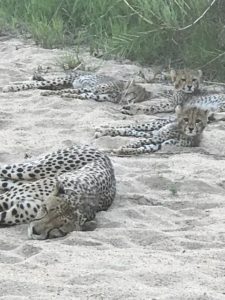
(Pictures by Cinnie Noble from Cheetah Conservation Fund International Research and Education Centre in Otjiwarongo, Namibia and from Karongwe Park, South Africa)
 Recently, a coaching client (I’ll call her Jane) retained me after her attempt to mend matters between herself and her co-worker (I’ll call her Martha) was unsuccessful. Jane told me that the relationship seems to have deteriorated all the more since she initiated an unsuccessful conversation with Martha and it’s now having an impact on other team members.